Why Your Agency Needs White-Label SEO to Compete with Big Box Firms.
Digital Marketing
Tanzim Sarwar Taz
Nominate a Leader
Celebrate Bangladesh’s pioneers.
The competition in the field of digital commerce is increasing daily. For smaller agencies, it often feels like you’re in a constant race to keep up with big firms that have more resources.
But what if you could level the playing field without hiring a larger team or draining your budget? White-label SEO could be the solution your agency needs to compete with bigger firms.
In this article, we’ll explore what white-label SEO is, why it’s essential for your agency, and how it helps you stay competitive. You’ll also learn about the benefits, risks, and how to choose the right provider for your needs.
What is White-Label SEO?
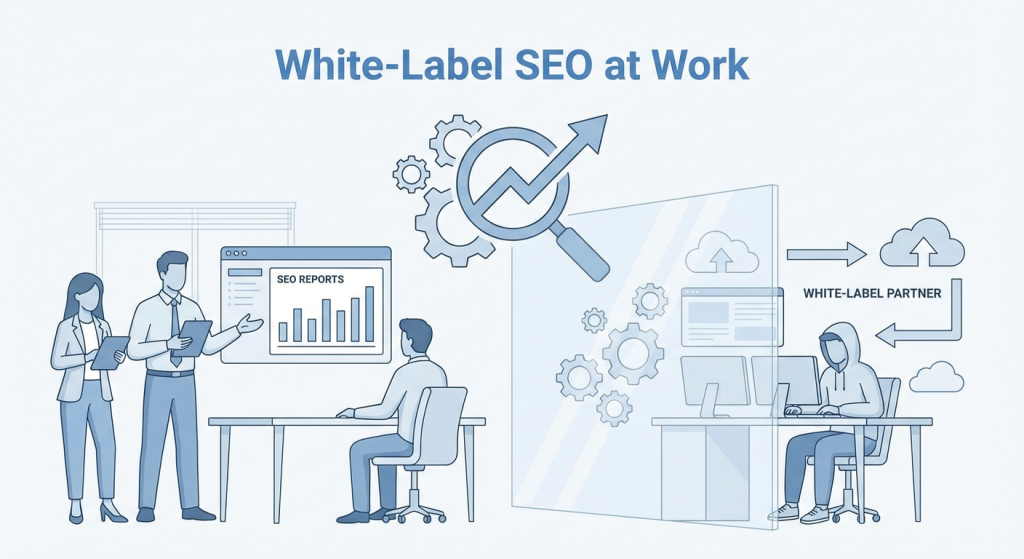
White-label SEO refers to SEO services provided by a third-party company that your agency can rebrand as your own.
It’s a simple concept: you partner with an expert SEO provider to handle the technical work while your agency takes care of client relationships, branding, and communication.
This model allows agencies to offer professional SEO services without needing to hire SEO experts or invest in costly tools. You simply resell the services as if they are your own.
White-label SEO provides a way for agencies to expand their service offerings without overextending themselves. Let’s dive deeper into how it compares to traditional in-house SEO.
White-Label SEO vs In-House Teams
Agencies often compare white-label SEO to hiring an internal SEO team. Both are valid approaches, but they support different stages of growth and financial realities.
In-House SEO
Building an internal SEO department involves recruiting, managing, and training talent over time. This approach typically includes:
Hiring SEO strategists, analysts, and writers
Purchasing tools such as Ahrefs, SEMrush, and Screaming Frog
Creating standard procedures and documentation
Providing ongoing certifications and learning
Handling HR, salaries, and infrastructure
A single mid-level SEO specialist in the United States often costs between $55,000 and $90,000 dollars per year, not including writers, developers, or data roles that support SEO work.
The benefit of this approach is full control over quality, culture, and communication.
If your agency already has consistent SEO demand and a stable client base, building in-house can eventually make sense. However, it requires both time and capital.
White-Label SEO
With white-label SEO, you buy SEO fulfillment capacity instead of hiring employees. You pay for services delivered instead of salaries. This offers three primary advantages for agencies that want to grow:
Lower financial risk because there are no salaries or benefits
Immediate access to experienced SEO specialists who know current best practices
Flexible scalability based on client volume without internal hiring cycles
White-label SEO does not replace your role as strategist, account manager, or advisor. Instead, it strengthens your ability to deliver high-quality results without production bottlenecks.
Why White-Label SEO Has Become Essential
Agencies rarely struggle because they cannot sell. They struggle because they cannot keep up with the same pace at which they sell. You may have experienced this already.
You sign three new SEO clients, fulfillment becomes overwhelming, and suddenly, growth feels like a burden instead of a win.
White-label SEO removes that bottleneck. It increases your delivery capacity without forcing you to build an internal team. Now, let’s look at why this matters in the current agency landscape.
1. You Can Compete With Larger Agencies Without Matching Their Headcount
Enterprise agencies often secure deals because they can offer:
Multi-channel digital services
Dedicated SEO fulfilment teams
Detailed reporting and dashboards
Consistent output and timelines
White-label providers already operate like enterprise production teams. When you connect your agency to that system, you instantly upgrade your capabilities. You gain confidence in proposals because you know you can deliver what you promise.
This helps you:
Retain clients who might otherwise outgrow you
Bid on larger and more profitable projects
Position your agency as a full-service partner
The market rewards agencies that deliver results, not those with the biggest headcount. White-label SEO gives you the results capability without the payroll commitment.
2. You Can Scale Without the Hiring Rollercoaster
Agency growth is rarely steady. One month, you sign multiple SEO retainers, and the next month, you sign none. This volatility makes full-time hiring risky. Payroll remains fixed even when demand drops.
White-label SEO lets you scale up or down based on active demand. You pay for known workloads rather than speculative staffing. This is extremely valuable if you are:
Expanding into SEO for the first time
Testing new verticals or industries
Managing seasonal workload changes
Not ready to commit to in-house SEO salaries
Predictable scalability is one of the primary reasons agencies adopt white-label models during growth stages.
3. You Gain Access to Tools and Specialized Skill Sets Without Buying Them Yourself
Modern SEO is not a single skill. It includes technical optimization, content strategy, analytics, schema markup, local SEO, link building, and more. Very few individuals excel at all of these.
Hiring multiple specialists at once is expensive. Freelancers come with variable quality and limited availability. White-label providers solve this by employing multidisciplinary SEO teams that already work with advanced tools such as:
SEMrush
Ahrefs
Surfer
Screaming Frog
Majestic
Agency Analytics
Google Search Console
Google Analytics
These tools alone can cost between $600 and $2,500 dollars per month, which is not cost-effective for many smaller agencies. With white-label SEO, you gain this expertise without owning the tool stack.
Most Agencies Hit a Fulfillment Ceiling!
Download the white-label SEO checklist and learn how growing agencies break through it.
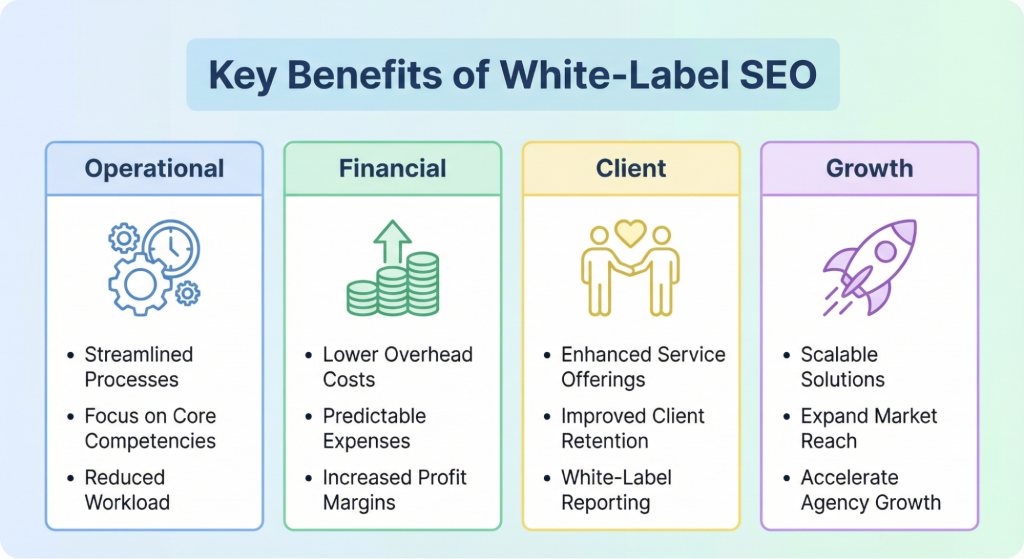
To avoid repeating benefits in multiple different sections, here are the primary advantages organized into four distinct categories.
Operational Benefits
You expand services without hiring new staff
Fulfillment bottlenecks are reduced
No training or onboarding cycles are required
Capacity increases instantly when demand increases
Financial Benefits
You avoid salaries, benefits, and HR expenses
You eliminate software and tool subscription costs
Service margins become easier to predict
You only pay for fulfillment when it is needed
Client Benefits
Deliverables become more consistent
Turnaround times improve
Reports look professional and data-driven
Client satisfaction and trust increase
Growth Benefits
You can bid on larger SEO retainers
Client lifetime value increases
Churn decreases because you offer more services
You position your agency as a full-service agency instead of a single-service
If you have ever wanted to scale your agency faster but felt constrained by fulfillment, white-label SEO directly solves that specific constraint.
Potential Risks and Considerations
White-label SEO is a strong growth model, but we should be realistic. There are a few risks and management concerns that you need to understand before you move forward. None of these is a deal breaker, but they deserve your attention.
Managing Client Expectations
When you outsource fulfillment, you still own the client relationship. That means you are responsible for communicating timelines, educating clients on SEO outcomes, and handling performance conversations.
To manage expectations effectively:
Set realistic timelines for rankings and traffic growth
Explain that SEO is a long-term process and not quick results
Request clear information about your client’s goals and history
Share reporting regularly so clients can see progress
If you communicate clearly from the beginning, white-label fulfillment becomes seamless for both you and your clients.
Maintaining Brand Alignment
White-label providers operate behind the scenes, but you still want the service to reflect your standards. That means you should ensure that the tone, reporting style, and deliverables align with your agency’s brand experience.
Here are practical ways to maintain brand consistency:
Request branded reporting templates
Review the provider’s work samples before onboarding
Set quality guidelines on content, on-page edits, and link placement
Keep internal documentation on how you package SEO services
When both teams are aligned, clients experience your brand as unified and professional.
Communication and Transparency
We need to acknowledge one important point. The biggest failure point with white-label relationships is communication. If communication breaks down between you and the provider, your client will feel it immediately.
You can avoid communication challenges by:
Clarifying points of contact for each account
Agreeing on turnaround times for tasks and responses
Using shared project management tools
Scheduling periodic check-in calls
White-label fulfillment works best when communication flows smoothly between all parties involved.
Most Agencies Hit a Fulfillment Ceiling!
Download the white-label SEO checklist and learn how growing agencies break through it.
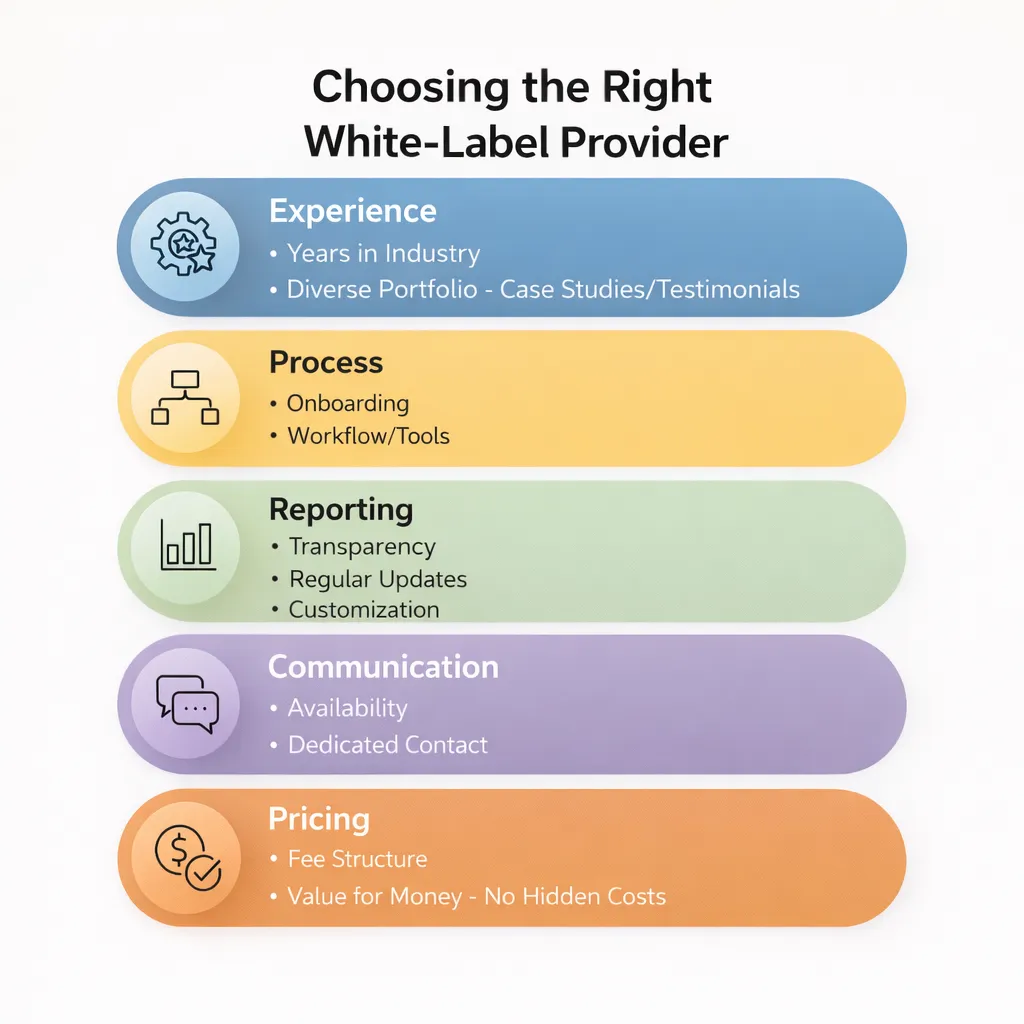
Selecting a provider is not just about pricing. You are trusting them with your reputation, your client relationships, and your ability to deliver. Let’s go through the evaluation criteria that will help you choose wisely.
1. Experience and Industry Focus
Not all providers work with the same industries or SEO models. Some are stronger in local SEO, some excel in national campaigns, and others specialize in technical or e-commerce.
Before you choose a provider, look for:
Years of operation
Industry familiarity
Campaign portfolio
Experience in your target niche
If you serve local service businesses, you need a provider who understands local ranking factors, map listings, and review signals. If you serve e-commerce brands, you need a provider who knows schema, product feed optimization, and CRO.
2. Fulfillment Capabilities and Processes
Great SEO is a process. That means your provider should have clearly defined workflows for:
Keyword research
Technical auditing
On-page optimization
Content creation
Link acquisition
Reporting
Ask the provider to walk you through their fulfillment process from start to finish. If they struggle to explain their methodology, that is a red flag.
3. Reporting Transparency
Clients judge value through reports. If reporting is weak, credibility suffers, even if the SEO work was solid. A strong white-label provider should offer:
Branded reports with your logo
Clear KPI tracking
Historical performance data
Traffic and ranking insights
Conversion metrics when possible
If you want to appear reliable, your reporting must look reliable.
4. Deliverable Quality and Consistency
Quality matters. Content, on-page edits, backlinks, and technical fixes can affect rankings and brand credibility. Before you commit, ask for:
Content samples
Link placement examples
Technical audit templates
Reporting templates
If quality does not meet your standards at the sample stage, it will not magically improve later.
5. Communication and Support Structure
Support matters because SEO is not static. You should know how quickly your provider responds and who you contact when you have questions.
Before signing, clarify:
Average response times
Support channels
Ticketing or task management systems
Onboarding processes
Reliable communication is a major success factor in white-label partnerships.
6. Pricing and Margin Alignment
Lastly, the economics need to make sense. You need enough margin to price competitively without destroying profitability. Look for providers who are open about pricing, scope of work, and terms.
Good providers will help you calculate margins and packaging, rather than pushing you into unclear agreements.
Ensuring Long-Term Success With White-Label SEO
Once you choose a partner, the relationship becomes an extension of your agency. To ensure long-term success, treat the provider as part of your operational ecosystem.
Here are proven practices:
Set Clear KPIs
Your clients might care about lead volume, rankings, or organic revenue. You need to translate those goals into measurable KPIs with your provider. When KPIs are clear, performance conversations become smoother.
Integrate Project Management
Do not manage white-label via email alone. Use tools such as:
Asana
Trello
ClickUp
Basecamp
Monday
Slack
Structured tools prevent missed requests and delayed responses.
Review Progress Regularly
Let’s be honest. SEO builds momentum over time. If you wait six months to review performance, you risk avoidable churn. Monthly check-ins help you adjust strategy and maintain transparency.
Refine Your Packaging and Sales Process
When SEO fulfillment is handled by a white-label partner, you can spend more time improving:
Sales scripts and proposals
Client onboarding
Pricing and packaging
Upsell and retention strategy
The agencies that grow fastest are agencies that treat SEO as a system rather than a single service.
Conclusion
White-label SEO is not just outsourcing. It is a scalable growth model that allows your agency to offer real SEO expertise without the hiring burden, training cost, or tool investment.
By integrating a white-label provider into your operations, you can improve fulfilment capacity, win larger deals, and retain clients longer.
If you are looking to expand your service offerings, reduce operational stress, and maintain strong margins, a reliable white-label partnership can make that possible.
If you want to explore a partner that understands agency fulfilment and brand integrity, Notionhive offers white-label solutions that help agencies scale without sacrificing quality or control. Contact us to get started today!
Most Agencies Hit a Fulfillment Ceiling!
Download the white-label SEO checklist and learn how growing agencies break through it.
1. What is white-label SEO, and how does it work? White-label SEO is when a provider performs SEO tasks under your agency’s brand. You manage the client relationship, and the provider handles fulfillment behind the scenes.
2. Will clients know that the work is outsourced? No, not unless you choose to disclose it. Reports and deliverables are presented under your branding.
3. Do I need SEO experience to offer white-label SEO? Basic knowledge helps, but you do not need to be an expert. Your provider handles execution while you handle communication and strategy.
4. Can I adjust my scale in response to demand? Yes. White-label models are flexible, so you can increase or decrease fulfillment without hiring or layoffs.
5. What types of SEO can be white-labeled? Most providers offer local SEO, national SEO, technical SEO, link building, e-commerce SEO, and content SEO.
6. How do I choose the right white-label partner? Evaluate expertise, fulfillment process, reporting, quality, communication, and pricing.
7. Can white-label SEO improve client retention? Yes. Offering SEO as an add-on service increases client lifetime value and reduces churn.
8. What tools do white-label providers use? Providers typically use tools such as SEMrush, Ahrefs, Surfer, Screaming Frog, Google Search Console, and analytics platforms.
9. How soon can clients expect results from SEO? SEO is a long-term strategy. Clients typically see meaningful improvements within three to six months, depending on competition and website health.
10. Can white-label work for agencies that only offer paid ads or design? Yes. Many design or paid media agencies use white-label SEO to expand services without retraining their team.
Get your business featured on established websites. Increase your search engine rankings with relevant backlinks. Boost trust and deliver long-lasting benefits that help you beat the competition.
We’ll get back within 10 business hours
How White Label SEO Helps Agencies Scale and Compete